
Walk into the comms room of a typical new apartment building and you’ll often find five or six separate systems sitting side by side. The intercom has its own cabling and hardware. So does the CCTV. Access control is on another system, the EV chargers on another, and the common area WiFi on yet another. Resident internet sits off to the side, sometimes installed by someone else again.
Each system works on its own. Together, they create a building that’s harder to manage, more expensive to maintain, and frustrating for the people who live there. There’s a better way to do it, and it starts with treating the network as one piece of core infrastructure rather than a collection of separate add-ons.
Nobody sets out to build a fragmented building. It happens because each system gets specified by a different supplier. The security contractor brings their CCTV design. The intercom supplier brings theirs. The electrician handles the EV chargers. Each one runs its own cable, installs its own switches and routers, and signs its own maintenance agreement.
No one is responsible for how it all fits together. Riser and pathway space gets used up by duplicate cabling. Equipment gets installed wherever there’s room left over. By handover, the building has a stack of separate systems, each with its own vendor, its own support number and its own contract.
The alternative is a single, well-designed network that carries every building service. Intercom, CCTV, access control, EV chargers, common area WiFi and resident internet all run over the same fibre backbone and the same core equipment.
That doesn’t mean everything is mixed together. A well-designed network separates each service into its own secure segment. The CCTV cameras can’t see the intercom traffic. Residents can’t see the access control system. Each service behaves as if it has its own dedicated network, but it’s built, managed and supported as one.
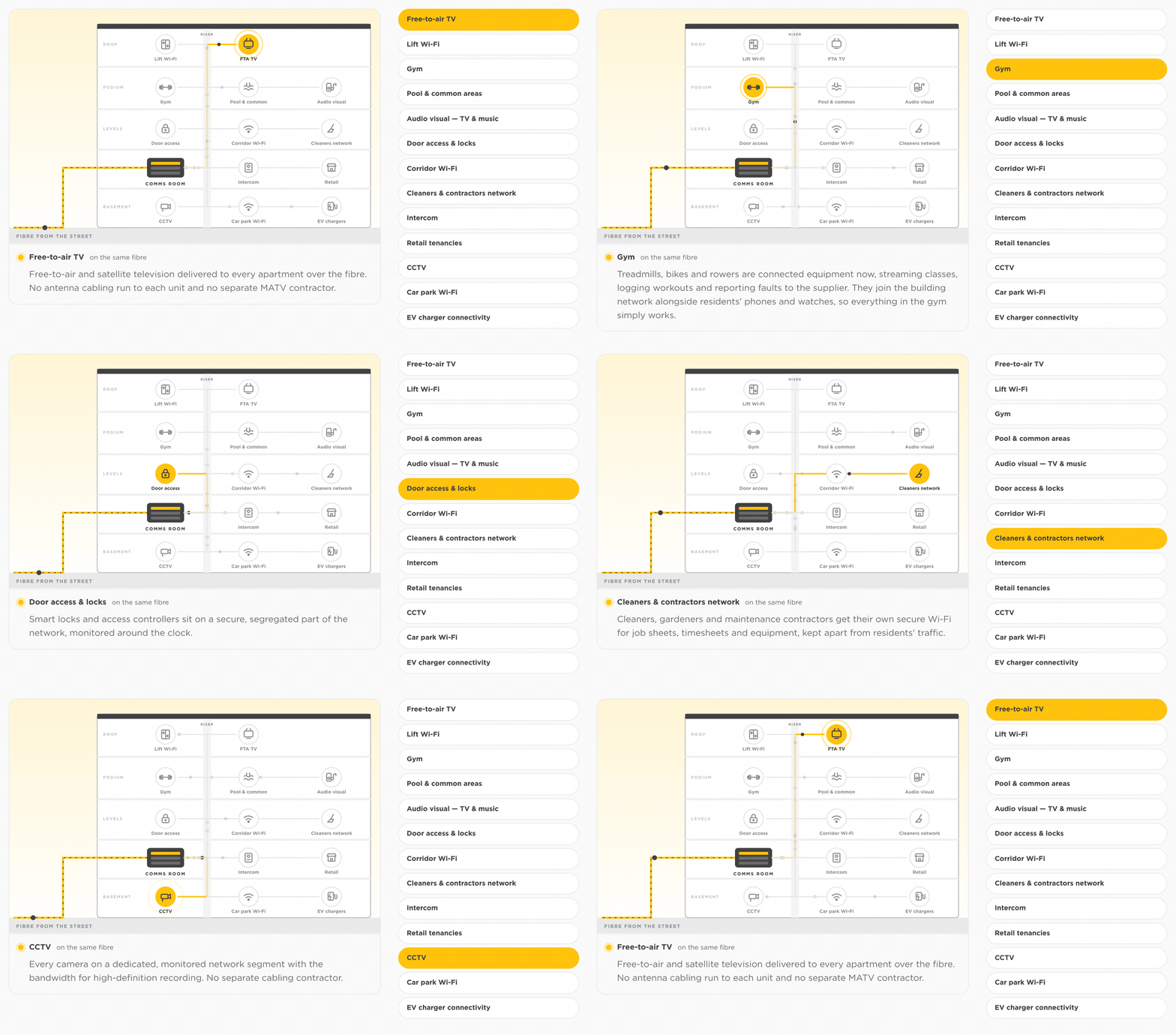
Less duplication. One backbone means less cabling, fewer switches and less equipment competing for space in risers and comms rooms. That space can go back to the building.
Fewer trades to coordinate. Instead of each trade designing its own network, they connect their devices to one network that’s capable of securely handling all of the building services. The intercom, CCTV and EV charger suppliers still supply their equipment. They just don’t need to build a network to run it on.
One point of accountability. When something doesn’t work during commissioning, there’s one party responsible for the network. No finger-pointing between vendors over whose system is at fault.
A cleaner handover. The body corporate inherits one network with one support arrangement, not a folder of separate contracts that nobody fully understands.
The benefits carry through to the building’s whole life.
Faults get diagnosed faster because the network is monitored as a whole, not in separate pieces. If the intercom stops working, the provider can see straight away whether it’s a network issue or a device issue.
It also makes the building easier to upgrade. Almost every new building technology needs a network connection; more EV chargers as demand grows, smart locks, parcel lockers, energy monitoring, environmental sensors. In a building with one network, adding a new service means connecting it to what’s already there.
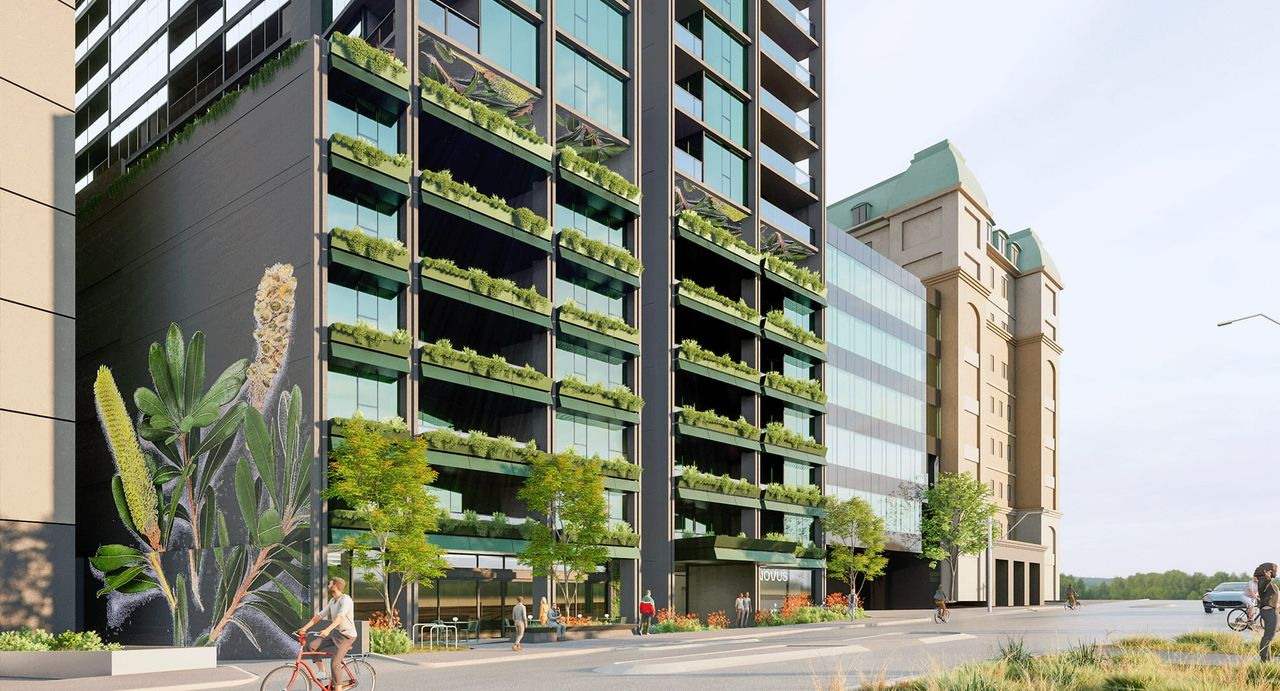
Novus on Bowen is an 18-level build-to-rent tower at 2 Bowen Crescent, Melbourne, reworked by Rothelowman for Novus. It sits beside the new Anzac Station, is all-electric and aims for net zero in operation, with a rooftop terrace overlooking the Domain and Albert Park.
Gigafy designed and built the building’s network, which has been live since August 2026. Fibre is terminated inside each of the 214 apartments, and television is distributed over the same network. So is everything else the building needs connectivity for including the intercom, CCTV, access control and WiFi across the common areas all of which run on the one network.
For a build-to-rent operator, this matters. Novus owns and operates the building for the long term, so every system that’s harder to support is a cost they carry for decades. One network means one partner accountable for connectivity across the whole building, from the resident’s apartment to the front door.
If you’re planning a development, these questions will tell you quickly whether a provider can deliver one network for the whole building:
The best time to design one network for a building is before the trades lock in their own systems. Once each contractor has specified separate cabling and equipment, consolidating becomes much harder and more expensive.
Gigafy designs, builds and operates networks for multi-residential developments across Australia, carrying resident internet and building services over one network. If you’re planning a development, talk to us early in design and we’ll show you what one building, one network looks like for your project.

